Bespin : Another promissing tool from Mozilla Labs
I hope you have already read or heard about Bespin. It is an web based code editor which can be used for "cloud computing" or just collaborating projects.
It boasts of the following features:
- Ease of Use
- Real-time Collaboration
- Integrated Command-Line
- Extensible and Self-Hosted
- Fast
- Accessible from Anywhere
Here is the screen shot of Bespin editing a HTML file.

Bespin has an interesting Dashboard to manage files and projects.


Visit
Bespin project page for more details.
Labels: IT, Mozilla, Operating Systems, OSS
Chepest Laptop (Under $10)
The 'world's cheapest laptop', developed in India, was unveiled by Union Minister for Human Resources Development Arjun Singh at the Tirupati temple on Tuesday evening.
The laptop, jointly developed by several organisations, such as the University Grants Commission, the Indian Institute of Technology-Madras, and the Indian Institute of Science, Bangalore, will be priced at around $10 to $20 (about Rs 500 to Rs 1,000), officials said.
S K Sinha, joint secretary in the ministry for education, giving a demonstration of the device which is smaller than the normal laptop, said that it will need some more fine-tuning. He said the laptop is expected to reach the market in about six months.
Arjun Singh had an interaction with the vice chancellors of the remote states like Jammu and Kashmir and Manipur to prove the point that the device will be able to bring about high quality networking among the various institutions of higher education and also increase the skills of e learning of the students in rural areas.
The project has already created a buzz in the laptop industry across the world.
The laptop has 2 GB onboard memory with wireless Internet connectivity. To make it useful for the students, especially in the rural areas, the scientists have made it low power consuming gadget.
The mission was launched at a huge gathering of academicians and the officials from across the country including thirty vice chancellors of central and state universities at the campus of Sri Venkateshwara University Tirupati.
Like the National Mission on Education through ICT, the laptop is also aimed at improving the skills of students, both at the school and higher levels. Under the mission the government also intends to provide high-speed Internet access to the schools to download e-books and e-journals and other material. Students will be able to download the material through the 'Sakshat' portal.
The goal of the national mission is to increase the enrollment in higher education in the country by 5 per cent over the next five years. The government will subsidise 25 per cent of broadband connectivity costs for private and public colleges.
The $10 laptop is being seen as India's reply to One Laptop per Child's XO and Classmate of Intel. The XO, created by scientist Nicholas Negroponte and MIT Media Lab was originally targeted to cost only $100 but by the time it was ready to enter the market its cost went up to $188. The Classmate notebook PC from Intel was priced at $ 300 a piece.
In contrast, the Indian government's effort to market lap top at only $10 has caused a flutter in the international laptop market and many players are curious to know the details of the costing and how Indians managed to keep the cost so low.
Rediff News : India unveils $10 laptop!And there were mixed reactions from all over the world.
More than 150 news articles already on google news I am eagerly waiting to hear /see more about it.
Labels: Computer, education, IT
Cloud computing is a trap, warns GNU founder Richard Stallman
Web-based programs like Google's Gmail will force people to buy into locked, proprietary systems that will cost more and more over time, according to the free software campaigner
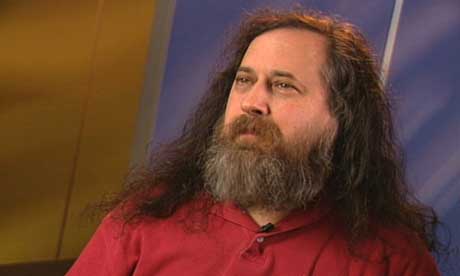
Richard Stallman on cloud computing: "It's stupidity. It's worse than stupidity: it's a marketing hype campaign." Photograph: www.stallman.org
The concept of using web-based programs like Google's Gmail is "worse than stupidity", according to a leading advocate of free software.
Cloud computing – where IT power is delivered over the internet as you need it, rather than drawn from a desktop computer – has gained currency in recent years. Large internet and technology companies including Google, Microsoft and Amazon are pushing forward their plans to deliver information and software over the net.
But Richard Stallman, founder of the Free Software Foundation and creator of the computer operating system GNU, said that cloud computing was simply a trap aimed at forcing more people to buy into locked, proprietary systems that would cost them more and more over time.
"It's stupidity. It's worse than stupidity: it's a marketing hype campaign," he told The Guardian.
"Somebody is saying this is inevitable – and whenever you hear somebody saying that, it's very likely to be a set of businesses campaigning to make it true."
The 55-year-old New Yorker said that computer users should be keen to keep their information in their own hands, rather than hand it over to a third party.
His comments echo those made last week by Larry Ellison, the founder of Oracle, who criticised the rash of cloud computing announcements as "fashion-driven" and "complete gibberish".
"The interesting thing about cloud computing is that we've redefined cloud computing to include everything that we already do," he said. "The computer industry is the only industry that is more fashion-driven than women's fashion. Maybe I'm an idiot, but I have no idea what anyone is talking about. What is it? It's complete gibberish. It's insane. When is this idiocy going to stop?"
The growing number of people storing information on internet-accessible servers rather than on their own machines, has become a core part of the rise of Web 2.0 applications. Millions of people now upload personal data such as emails, photographs and, increasingly, their work, to sites owned by companies such as Google.
Computer manufacturer Dell recently even tried to trademark the term "cloud computing", although its application was refused.
But there has been growing concern that mainstream adoption of cloud computing could present a mixture of privacy and ownership issues, with users potentially being locked out of their own files.
Stallman, who is a staunch privacy advocate, advised users to stay local and stick with their own computers.
"One reason you should not use web applications to do your computing is that you lose control," he said. "It's just as bad as using a proprietary program. Do your own computing on your own computer with your copy of a freedom-respecting program. If you use a proprietary program or somebody else's web server, you're defenceless. You're putty in the hands of whoever developed that software."
Story
You may also like to read
Labels: Cloud Computing, google, internet, IT
Microsoft + Yahoo! vs Google ?
The news in Tech circle for last few days is about merging of Microsoft and Yahoo! and the main motive seen behind this is to counter Google growing market share. For few month it is believed that Yahoo! is not doing so well. And Microsoft has been struggling to get a larger piece of the Internet market pie, which is growing in terms of reach internationally and in cash turnovers n eCom.
Microsoft is the largest software company and Yahoo! was the largest internet company. But now Yahoo! has lost that spot to Google, which Microsoft has been eying for some time. Also over past few months Google has released an array of Free software tools and internet tools which are probably alarming Microsoft.

Now we have to wait and watch if the Microsoft and Yahoo! merger happens or not, and are they combined together able to check Google's growth.
I personally feel, in the end users will benifit, since both Microsoft and Google will put their best to offer diverse, user friendly and robust services for free or at competitive rates.
Related Stories
Labels: google, IT, web
Sun acquires MySQL
This morning, Sun Microsystems announced plans to acquire MySQL AB.

The world’s biggest contributor to Open Source SUN: Open Office, Java (now under GPL), GlassFish, NetBeans — and soon MySQL
About MySQLAbout SUN
Read More about the deal
Labels: FOSS, IT, MySQL, SUN
Book : The Google Story
Finally I got hold on the book "The Google Story" by Devise Vise. I have
been hearing about this book for few months. And wanted to read it.

I ave not finished the book, but just started reading. After going
through Preface and few chapters, I am convinced that everyone should
read it. Specially people using internet, in IT field and students of
Computer Science it is a must read.
The book describes the story behind Google. How the technology and the
business model evolved and has become a successful one. Google is not
that old company. Just started in 1998 and has already become threat to
the monopoly of established players in the market in certain areas.
I will post some more interesting things form the book soon.


Labels: Computer, FOSS students, IT, web
BIOTIK : Software to identify tree species
Last week I got an opportunity to attend the release function of BIOTIK in Bangalore. BIOTIK stands for Biodiversity Informatics and co Operation in Taxonomy for Interactive shared Knowledge base.
A.K. Verma, Principal Chief Conservator of Forests, Karnataka state was the chief guest.
The software demo was given by Dr, B R Ramesh and team. The characters are entered interactively and without any taxonomically jargon. Everything has a simple and elegant user interface. I found the interface intuitive too. Narrowing down of 100% matching species gives a clear picture of how near are we in the search. The software works on PC and PDA for the tie being, but soon will be available on internet too. They have also promised to make it open source.

Users got opportunity to try the software on PDA and PC during the break. So far about 300 species data is available and ultimately by March 2008 full version with 600 species will be available for Western Ghats. Similar project is done in Lao.
Another highlight for me was meeting Dr. Pascal personally. Dr, Ramesh and Dr. Pascal are well known for the forest maps French Institute of Pondicherry (http://www.ifpindia.org/), which are used by most of the people working on Western Ghats data.
More info on BIOTIK
hereand news in Hindu
hereLabels: Computer, conservation, diversityindia, IT
e-ticketing everywhere
It’s everywhere and everyone’s doing it. Be it flying, traveling by train or going to a movie—e-ticketing is becoming the preferred mechanism.
 For the record we thought that it would be interesting to rattle off some statistics that speak volumes about the growth of e-ticketing in transportation.
The online passenger reservation site of Indian Railway Catering and Tourism Corporation Ltd’s (IRCTC) sales from the Internet booking of train tickets in a single month (August 2007) totted up to a staggering 12,90,608 tickets generating revenues of Rs 110 crores. Direct online ticketing now accounts for 40 percent of the tickets sold at most airlines. Air Deccan does an average of Rs 30 million worth of transactions per day.
These are exciting times for Indian e-ticketing. Sales are robust and large corporations and enterprises are pulling out all the stops in their attempts to grow online sales. Online ticketing has caught on with high acceptance in the Indian market. There are many vendors who are trying to capture this space and large corporations are firmly behind online ticketing.
Story
Labels: Computer, IT, travel, web
Is web 3.0 really here ?
The transition from Web 2.0 to Web 3.0 may seem to be a faster one than from Web 1.0 to Web 2.0. The question remains, does this new version of the Web do anything for the end user?
Not very long ago, we were talking about the evolution of Web 2.0 and here we are already discussing another new term, viz., Web 3.0. To many, it may sound like another marketing gimmick while others may feel that it is just another name for upcoming Web 2.0 applications. To add to the confusion, major players in the Internet space themselves believe that there is no clear definition of Web 3.0. One thing is for sure; there is a new age of the Web that is about to place its foot in the mainstream and perhaps be the future of the Web.
StoryLabels: Computer, IT, web
More women to board IT bus
Indias booming IT and IT-enabled services industry is a favourite destination of job-seeking women, whose employment in the industry is set to rise dramatically to 45 percent in 2010 from the current 30 percent, says an industry survey.A survey by National Association of Software and Services Companies (Nasscom), the representative organisation of the Indian software firms, says this is due to the inclusive human resource policies of Indian IT firms, which recruit, train, retain and promote women employees as a strategic business plan.
Ratio to improve“As the IT-ITeS sector moves up the value chain, more women are joining the industry. The male-female ratio is expected to improve to 65:35 by this year-end from 76:24 in 2005,” outgoing Nasscom president Kiran Karnik said here on Wednesday.
“For empowering the women workforce and creating conducive environment to grow equally at their workplace, we have commissioned Indian Institute of Management at Ahmedabad (IIM-A) to conduct a fresh study on the status of women employees in the IT industry and avenues for their growth in the value chain,” Karnik told about 300 women delegates participating in the Nasscom-IT Women Leadership Summit 2007.
The study is likely to be completed in the next five-six weeks. “It is a survey of what the IT industry does and can do in terms of attitude, perception and practices for an inclusive growth,” Karnik pointed out.
The study will also quiz women employees across the industry to ascertain their assessment of the existing HR policies, work conditions, how sensitive their male counterparts were towards them, and scope for professional advancement in their respective organisations.
“The study is being conducted on various parameters to assess the growth prospects of women workforce in the industry. For instance, the penetration of women at the management level is still inadequate. Even at top levels, women representation is disproportionate,” Karnik noted.
As the nature of their occupation, which includes looking after domestic chores, is burdensome, the study will explore prospects of employing women with flexi-timing so that they could divide their work between office and home.
StoryLabels: Computer, IT
Print 2.0 – a New Era for Printing
HP is working on Print 2.0
Key areas of focus of the Print 2.0 strategy:
- Make it easier to print from websites, such as blogs and travel sites, and bring new printing capabilities to online properties;
- Extend the company’s digital content creation and publishing platforms – for example, Snapfish and Logoworks – across customer segments spanning from consumers to enterprises; and
- Deliver a digital printing platform that increases print speeds and lowers the cost of printing for high-volume commercial markets.
StoryStory in Express Computers 
Labels: Computer, IT
NComputing : Getting more from less
In a country like India with its wide digital divide, a solution like sharing computer processing and computing capacities could make a big difference. Shonali Misra finds out more about NComputing.Operating a computer these days is as routine as writing in a notebook (not the laptop!) Though computer prices have declined over the years, it is still difficult for every average middle-class person to be able to afford one. In this scenario, when any individual or organisation has an affordable as well as efficient option of computing, cyberspace seems so much more accessible.
Turning complexity simple enters the NComputing solution. Founded in 2003 by a Korean engineer, Young Song, and German inventor, Klaus Maier, dedicating more than 12 years of applied research in multiuser computing, NComputing breaks the affordability and complexity barriers that have limited the PC from being deployed everywhere.
NComputing, Inc. (www.ncomputing.com) is a privately held software and hardware technology design and manufacturing company with offices in Australia, Canada, China, Germany, India, Korea, Poland, Russia, the United Kingdom, and the United States. Headquartered in Redwood City, CA, the company's patented technologies drastically lower costs, improve manageability and reduce energy consumption.
Explaining how the system works, Mr Raj Shah, Chief Marketing Officer, NComputers, says, "The NComputing system is based on the simple fact that today's PCs are so powerful that the vast majority of users only need a small fraction of the computing capacity. Most users only tap one to five percent of the more powerful PC's processing power. NComputing taps this unused capacity so that it can be simultaneously shared by 7 to 30 users at a time."
Each user's monitor, keyboard, and mouse are connected to a very small and highly reliable NComputing access device, which is then connected to the shared PC. This thus brings down the cost of infrastructure, installation, and maintenance.

In addition to lower initial costs, the NComputing solution also lowers ongoing support costs. For example, the NComputing access devices only use one watt of electricity—compared to 120 watts of electricity for a dedicated PC.
The 95 percent electricity reduction is especially critical in India where electricity rates are high with India facing a 70,000 MW power shortage along with power supply being unreliable, adds Shah. The lower power consumption also reduces the need for uninterruptible power supply (UPS) systems and inverters.
Finally, since fewer PCs need to be maintained, the support, maintenance and replacement costs are significantly lower. The additional bonus is an 80 percent reduction in e -waste.

How it works
With the NComputing solution, each user still has his/her own monitor, keyboard, mouse and speakers. However, instead of connecting directly to a PC, these peripherals connect to a small NComputing access terminal on their desk. The access terminals connect either directly (X Series) or over Ethernet (L Series) to the terminal services software using the high performance User eXtention Protocol (UXP).

Presence in India
With a two year presence in India already having delivered around 200 seats, the company plans to work with the central and state government bodies, Non-Government Organisations (NGOs) and school systems. Azim Premji Foundation, Jindal South-west (JSW) - Vijaynagar Steel Plant near Hospet, Apollo Hospitals in Bangalore, and RV Public Girls school, Bangalore, are a few of the local names who have opted for the simplified computer solution. Digital Waves (http://www.digitalwaves.in/) is the Bangalore distributor for NComputers.
Story

Labels: Computer, Gizmo, IT
TATA CRL and HP Supercomputer ranked Fourth Best in the World

HP has announced a major milestone in world class supercomputing as the company has collaboratively worked with Computational Research Laboratories (CRL) for the development of the 4th most powerful supercomputer in the world and thus the most powerful in Asia-Pacific region.
CRL is a wholly-owned subsidiary of TATA Sons. HP had been working with CRL to evaluate and plan for an advanced HPC facility in India over the last year. In fact, using HP’s new High-end compute building blocks, CRL managed to successfully build their supercomputer.
CRL plans to use this newly developed supercomputer to push scientific and industrial discovery to infinite limits. For instance, using such a powerful supercomputer, engineers will now be able to model particle dynamics at ultra high resolution - allowing for significant breakthroughs in fields such as nano-photonics and medicine.
So where does HP come into all of this, you might be wondering. HP’s leading c-Class Blade System technology enabled CRL to put this supercomputer capability in place in a record one-month period.
CRL and HP have named this supercomputer “Eka”, which means the “one” in Sanskrit. In actual fact, this machine will act as a stepping-stone for CRL’s Petaflops Project.
Mr. S Ramadorai, Chairman, CRL spoke on this jubilant occasion stating, “This project, based on standard infrastructure building blocks from HP, will herald the availability of affordable research in India. This will pave the way for growth in the Indian research industry by providing affordable access to computational infrastructure to the vast existing research talent pool across verticals and domains.”
Mr. Balu Doraisamy, Managing Director, HP India Sales said, “HP is honored to partner with Tata CRL, a leading name in the field of High Performance Computing, from the inception stages of the project, all the way through its production. We are proud to work collaboratively with Tata CRL to take forward their vision of being a global leader in HPC, building scalable and cutting-edge supercomputer architectures while making affordable research in India a reality.”
The Eka system is one of the first implementations on Fiber Optical Infiniband cables, which have proven very reliable at lengths greater than those generally achieved by copper alternatives.
The 2.5 MW of captive power being generated to keep the Eka system going was a catalyst for Computational Research Labs to create a new data center model for Dense Data Center Layout and Innovative Network Routing Technology that will see advances for HPC future products.
The supercomputer is
powered by a Linux open source operating system and it is based on standard hardware to address the issue of application scalability, which has been the bane of supercomputing till date.
TechShout Story
Nature StoryBusinessLine StoryLabels: Computer, IT, Linux
20.025 !
Priya Ganapati
Classes are useless. If the company receives any resume and we find the guy has attended classes we throw the resume out," declares Bhavin Turakhia.
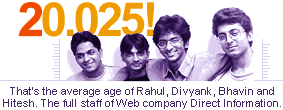
Bhavin is the 19-year-old director of Web hosting and applications development company Direct Information Private Limited. The company has built a turnover of Rs 400,000 over the last six months of its existence.
The unconventional HRD policy will not sound so drastic when you consider that the four-head-strong staff of Direct Information is hardly out of college and still at war with teachers who are generations removed.
Bhavin has just graduated from Bombay University with a bachelor's degree in commerce. But he founded Direct Information when he was still at college.
Web Promotion Executive Divyank Turakhia is 17 and the second founder. He is Bhavin's younger brother. Divyank is also studying to graduate in commerce and is currently in the first year of the programme.
Systems Analyst and Project Leader Hitesh Makhijani is 20. Hitesh joined the venture only two months ago. He too is going to graduate with a degree in commerce. Hitesh is in the final year.
Technical Support Executive Rahul Monga is the oldest man in the start-up. He is 23. Out of college for two years now... And considered over the hill by his colleagues.
"Yeah! He's the buddah out here..." chorus the others.
Full Story
Labels: IT, startup, web
Multimedia Linux device
| BS Reporter / Mumbai June 14, 2007 |
|
|
|
| It's an MP3 player, FM radio, video and photo display device, an e-book reader and a sound recorder – all bundled in one. |
|
| What more, it's a Linux-based personal computer ready for web, email and office use. Touted as the Swiss army knife of handheld gadgets, Wizpy, has now been launched in India by Japan-based Turbolinux. |
|
| The nifty tool which is a multimedia media player that contains a PC-bootable version of the Linux operating system is priced at Rs 11,995. |
|
| “This palm sized mobile device enables the user to have their own personal computer environment through which they can access documents, e-mails and the internet, keeping their data secure and confidential,” said Deepak Wassan, president, Turbolinux. |
|
| Pegged as a ‘PC 2.0’ product, Turbolinux has partnered with eSys Technologies and online portal cafegadgets in for distribution in India. “Early adopters who are curious about using Linux but either don't want to or can't install the operating system are our target customers,” he said. |
|
| Bouyed by its success in universities of Vietnam, the company is aiming to gain foothold in the education sector moving on to the corporate sector before targeting the home users. |
|
| The pocket-sized device, that can play audio and video files, is really a Linux carrot of sorts, allowing users to store a complete Linux desktop in its memory. “You can plug the Wizpy into a PC's USB port and boot up the Linux system with all its user settings, passwords, bookmarks, etc,” added Wassan. |
|
Turbolinux will ship 50,000 units of Wizpy to India by the end of this fiscal and also plans to introduce products in the middleware and applications areas.
Story

|
Labels: Computer, Gizmo, IT, Linux
Introducing Gmail Paper
Beginning of the month we all saw this on the gmail front page. And I started wondering what business model is Google following for this one ?
New! Introducing Gmail Paper |
|
Everyone loves Gmail. But not everyone loves email, or the digital era. What ever happened to stamps, filing cabinets, and the mailman? Well, you asked for it, and it’s here. We’re bringing it back.
 | A New Button
Now in Gmail, you can request a physical copy of any message with the click of a button, and we'll send it to you in the mail.
Simplicity Squared
Google will print all messages instantly and prepare them for delivery. Allow 2-4 business days for a parcel to arrive via post.
Total Control
A stack of Gmail Paper arrives in a box at your doorstep, and it’s yours to keep forever. You can read it, sort it, search it, touch it. Or even move it to the trash—the real trash. (Recycling is encouraged.)
Keep it Secret, Keep it Safe
Google takes privacy very seriously. But once your email is physically in your hands, it's as secure as you want to make it.
Learn more about Gmail Paper |
And after few days I realized, Gmail has fooled me. One of the best April Fool pranks I came across.
Labels: April Fool, google, IT
 Vijay Barve
 Bespin has an interesting Dashboard to manage files and projects.